
Free Property Search
Find Your Next Wholesale Deal, House Flip, or Rental Property Investment.
Search Now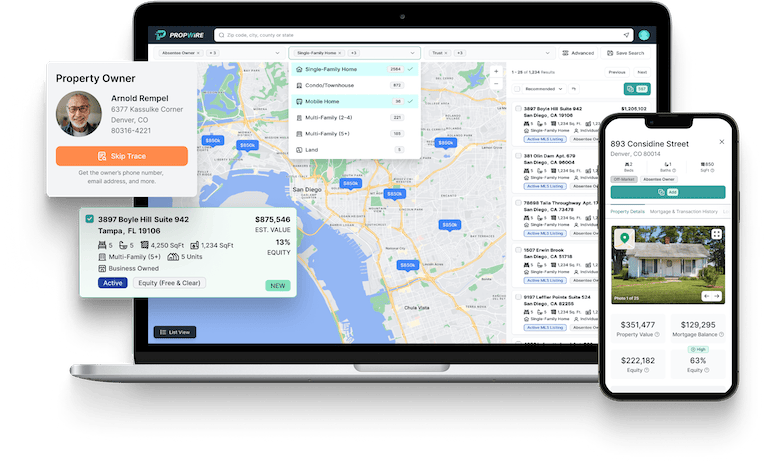
Jerry Norton
Jerry Norton
Dec 20, 2023

You’ve found a property you want to invest in — great!
But is the asking price below market or above market?
Or, you’re considering flipping a home.
How much can you sell it for once the renovations are complete, and how much of it will be a profit?
Welcome to the world of real estate comps — comps, of course, standing for comparables.
In this article, we’ll break down how you can find the most accurate and cheapest real estate comps today.
Ready?
Let’s get started!
Comps in real estate are useful in determining how much a subject property is currently worth — or once renovations are completed.
When looking at comparable properties in the same area as the subject property, you get a comprehensive view of price points for that neighborhood and how they relate to a property you are thinking of investing in.
Sellers also use these comps to price their properties accordingly, ensuring they are getting the best value possible.
For example, when investors consider a property, they want to know the value of the houses within a one-mile radius. This tells them what they can get for their subject house once they renovate and repair it.
If the average value of the neighborhood properties is significantly higher than the subject property, there is a profit to be made.
This is where something called ARV — after repair value — comes in. Taking the purchase price of the house and adding their estimated repair or renovation costs then considering the average costs of nearby similar houses will provide an ARV.
Sellers can be someone who has lived in the house for years or can be an investor who is flipping the house.
Either way, when they are ready to sell, they use comps to price their properties to sell.
By evaluating nearby properties that have recently sold, they can properly price their home.
Now that you know the importance of comps, take a look at 10 ways to find them.
Propwire is the best way to find the most accurate comps quickly. By using the up to date MLS — where you can search 157+ million MLS & off-market properties for free — comps are automatically populated on a map, with a detailed view of each property.
But that’s not all.
Once you select a property, you’re able to find and contact the owner of the property by using the skip trace feature for just 10 cents.
Learn more about it here.
Using Zillow to find comps is free, but a little more time-consuming. Locating the subject house on their map, you can set filters to sold, type of property, and sold in the last number of days.
Properties will show on the map where you can see the square footage of the homes, number of beds and baths, lot size, and other features.
This is a great way to compare your subject property.
Redfin is another popular real estate site where you can find comps on similar houses that sold nearby.
Being able to see the properties laid out on the map, gives you a bird’s eye view of the neighborhood’s value.
Another way to obtain real estate comps is to have a real estate agent — perhaps one you have worked with before — for you.
You can find public property records on your city or county website that can show the comparables in your given area.
Because wholesalers liaison between real estate agents and buyers, they are usually prepared with comps on properties.
An appraiser can easily give you the value of a subject home and will pull comps to come up with that value.
Next, we’ll take a look at some of the most commonly asked questions associated with real estate comps.
Comps are determined by the square footage of a home, number of bedrooms and bathrooms, lot square footage, number of stories, garage or street parking, flat land or hillside, and zoning.
When comparing properties to your subject property you want to come as close as possible to matching most, if not all, of those things.
You’ll want to make sure that these properties were sold within at least 90 days.
Any longer and changes in the market could influence how much you would get for your property.
You also want to make sure the property is within a mile of your subject property and not on opposite sides of major freeways.
Views also determine if a property is comparable.
Even if a property is the same size with all the same features, but one has a view and the other doesn’t, they do not hold the same value.
Comps are used by sellers to arrive at a list price for their property.
By comping other similar properties, they can list their property to sell.
Sometimes, they may want to undercut, and lower their list price if they want to sell fast, or sometimes, they might go higher to give the appearance of more value.
An investor or flipper will want to see at least three solid comps to help decide on the property.
There you have it: real estate comps.
Real estate comps are a valuable way to price properties and to evaluate a property that’s on the market.
End buyers who are planning to live in a property or hold it for five or more years may not be as affected by comps as an investor or flipper who is looking to buy the property, renovate it, and sell it for a profit.
Effective comps are those that have sold in the last 90 days and that are not more than a mile away.
The more the properties match in size and features, the better the comps.
All in all, it’s always the buyer’s ultimate decision on whether to buy a property, and other factors go into it, but comps rate high on the list in the decision-making process.
Free Property Search
Find Your Next Wholesale Deal, House Flip, or Rental Property Investment.
Search Now