
Free Property Search
Find Your Next Wholesale Deal, House Flip, or Rental Property Investment.
Search Now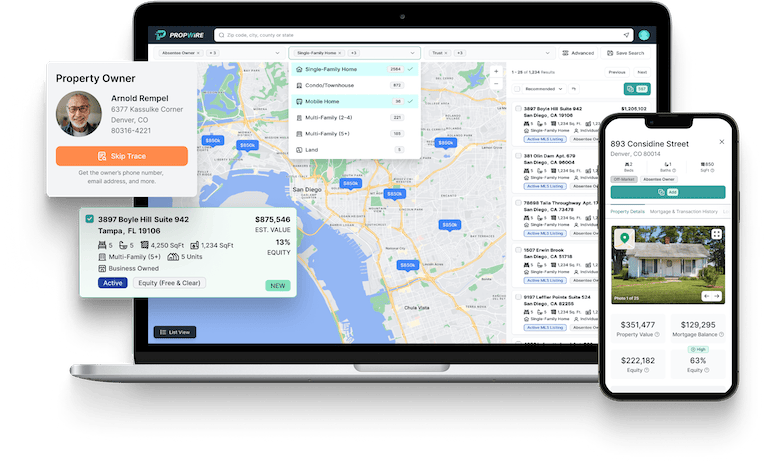
Jerry Norton
Jerry Norton
Aug 8, 2024

As a real investor, you’re looking for a below market deal that you can either fix and flip for a profit or turn into a rental property that can provide monthly cash flow.
To achieve this, you can look for vacant properties, tired landlords, REOs, or zombie properties.
There is another lead generation strategy that can help you find a property that is priced below the market to sell quickly — probate real estate.
In this article, we’ll break down the probate real estate process as well as how you can find probate properties to invest.
If an asset, such as a property, is in probate, that means it’s been left behind by someone who has passed away.
If the deceased person was the sole owner of the property, the property will go into probate, a court process of distributing all the person’s holdings, including the property.
This is generally because any heirs to the property may not want to maintain the property or live in it. Plus, they may want to emotionally move on from the property by selling it.
Now that we’ve defined probate real estate, let’s take a look at the probate process.
The probate process starts with the naming of an executor.
The executor will oversee the sale of the person’s holdings, including the property.
This person may have been named in a will, or if not, the court will appoint someone.
After the executor is appointed, he or she will hire a real estate agent to list and sell the property.
The real estate agent will conduct a property appraisal on the property to determine a listing price.
What sets probate sales apart — and why they can be advantageous for investors — is they are usually listed below market value to sell as quickly as possible and likely much cheaper than other properties in the surrounding area.
Once an offer is made by a buyer that is agreeable, the executor will ask the court for approval.
The court approval for the sale can take anywhere between 30-45 days, which is a disadvantage for the real estate investor looking to see an ROI on the property.
There are several ways — both paid and unpaid — to find probate properties in your local area to invest in. These include:
With Propwire’s up-to-date database, you can search through 157+ million MLS and off market properties — 100% free — specifically for probate properties.
It works like this: using Propwire’s search tool, simply toggle to “Lead Types” and choose “Probate”.
From that point, every property you see will be a probate property.
Once you find a property that you’re interested in, you can run a skip trace (for the price of 10 cents per skip trace) to speak with the real estate agent and/or executor to make an offer.
Your county or cities’ probate court will have a list of ongoing probate cases that you can review in person or online.
Several lead generation companies sell probate leads for a cost.
In some counties, notices of upcoming probate sales will be published in the local newspaper and/or on their website.
Because probate real estate properties are priced to sell as fast as possible, they can be a real estate investor’s gold mine.
Use Propwire’s probate database today to find your next — and most profitable — deal yet.
Free Property Search
Find Your Next Wholesale Deal, House Flip, or Rental Property Investment.
Search Now