
Free Property Search
Find Your Next Wholesale Deal, House Flip, or Rental Property Investment.
Search Now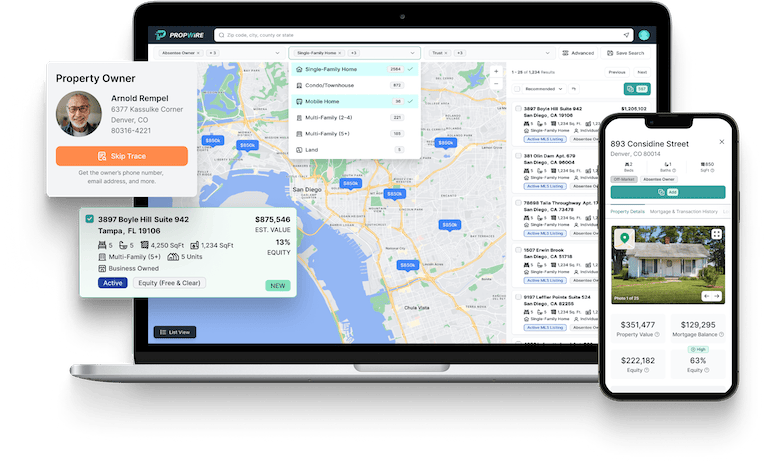
Jerry Norton
Jerry Norton
Aug 8, 2024

There are many real estate investing strategies — each with their own advantages and disadvantages.
In today’s digital-era, long distance real estate investing — investing in states outside of your residence — has grown in popularity.
It’s true: you don’t have to be limited to your neighborhood or local community to experience he benefits of real estate investing.
So is long distance real estate investing for you?
If so, how can you get started buying a property in a different state, in a different time zone, or even on the other side of the country?
We’ll answer all these questions — and more — in this long distance real estate investing guide.
Let’s get started!
Long-distance real estate investing refers to property purchases that are made outside of your localized market.
This can also mean buying across state lines or even across the country!
In other words, you will more than likely not be managing your own property. If the long-distance property is too far for you to manage, you’ll need to hire a property manager to take over the day-to-day operations.
Outsourcing to a local professional is the best bet for long-distance real estate purchases.
There are many advantages to purchasing long-distance real estate, including:
If your local real estate market is at a standstill, here’s the good news: you can invest somewhere where the market is hot!
One of the main advantages of investing in long-distance realty is the fact you can purchase a property anywhere.
You can reap the total benefits of up-and-coming markets that have an increased growing potential compared to your current area.
If you are looking to diversify their portfolio and bring in more income, long distance real estate investing is advantageous.
When you search outside your localized real estate market, you may be able to purchase a property for a lower cost.
Alternative areas across the country may offer better properties at lower prices.
If you live in a competitive market, it is best to purchase away from where you live. You have the ability to generate a great amount of passive income by buying long-distance properties.
There are several disadvantages of buying long-distance real estate that you should be aware of, including:
If you do not have a property manager, it will be nearly impossible to have success when investing in real estate long distance.
When you invest in a long-distance property, you run the risk of fraud. You may fall victim to a fraudulent deal because you are not in person to assess the property, the seller, and other factors.
It is easier to master the real estate market near you. It is much more difficult to learn the trends of the real estate market long distance as you are not there to witness it firsthand.
If long distance real estate investing is for you, here’s how to get started.
If you are looking to buy property in a specific location, start your research online.
Using up to date MLS data, Propwire offers the ability to search 157+ million MLS & off-market properties 100% free.
You can explore 21 valuable lead types, including:
But that’s not all. Once you find a property you’re interested in, you can skip trace for just 10 cents to find and contact the owner of a property.
If you have landed on a property of interest, now is the time to check the profitability.
Ensure your property is able to generate income beyond the cost of operating expenses.
If you are not going to generate a profit with the rent cost you establish, it may not be worth your while.
Be sure to find a property that allows you to charge a specific rent price so you can make more money from the renters.
The next step is to find reliable contractors.
You can begin your search online in addition to word-of-mouth and referrals from people who live in the area of your purchased property
Hiring a property manager can greatly alleviate additional stress and help you with day-to-day operations.
Since you are not local, this professional becomes the go-to person to:
Before you choose the first person who shows interest in your property, you must design and implement a tenant screening process.
Determine what factors are most important for potential tenants including but not limited to:
You are the landlord, so it is your job to find responsible tenants.
The better the tenant, the more peaceful your life, and the more stabilized your passive income becomes.
Since you do not live nearby, use landlord software to manage your properties. Several software programs exist that help streamline the entire rental process.
Through this software, you can:
Managing your rentals can be even easier long distance than having to deal with everything in person.
If your local real estate market has cooled off, you can still invest in hot real estate markets, even if they are across the country.
Utilize this guide to help you on long distance real estate investing journey.
Above all, be sure to hire a property manager, use landlord software, and implement a tenant screening process.
Whoever you choose to live in your long-distance home will provide cash flow — while the property earns equity— now and in the future.
Free Property Search
Find Your Next Wholesale Deal, House Flip, or Rental Property Investment.
Search Now