
Free Property Search
Find Your Next Wholesale Deal, House Flip, or Rental Property Investment.
Search Now
Jerry Norton
Jerry Norton
May 16, 2024

The process of buying real estate can be complex: paperwork, hard to understand jargon, and countless signatures.
Once it's done, you want to be onto the next step, whether that's flipping the property, wholesaling it or landlording.
The last thing you want is someone contacting you saying that they had interest or claim in the already property.
Yes, it can happen.
But there are tools that can prevent this: an Affidavit of Memorandum.
In this article, we'll break down everything you need to know about the document, including an Affidavit of Memorandum template for you to examine.
Let's get started!
An Affidavit of Memorandum is a written statement that outlines the details of a financial claim or interest in a property.
It’s often used to protect the interests of a party who has a financial stake in a property, but is not listed as the owner on the deed. It protects the party with a financial interest by preventing the sale or transfer of the property without their knowledge or consent.
It's not just a piece of paper you file away in your office; it's public record filed with the county clerk's office to provide notice to anyone interested in purchasing the property or conducting a title search.
Without an Affidavit of Memorandum, a buyer could unknowingly purchase a property with undisclosed financial encumbrances or disputes, which could lead to significant complications and legal disputes down the road.
An Affidavit of Memorandum typically includes several key components:
Now that we know what an affidavit of memorandum is, let's take a look at how to document one. This process includes:
Once it's documented, what's the next step? It includes:
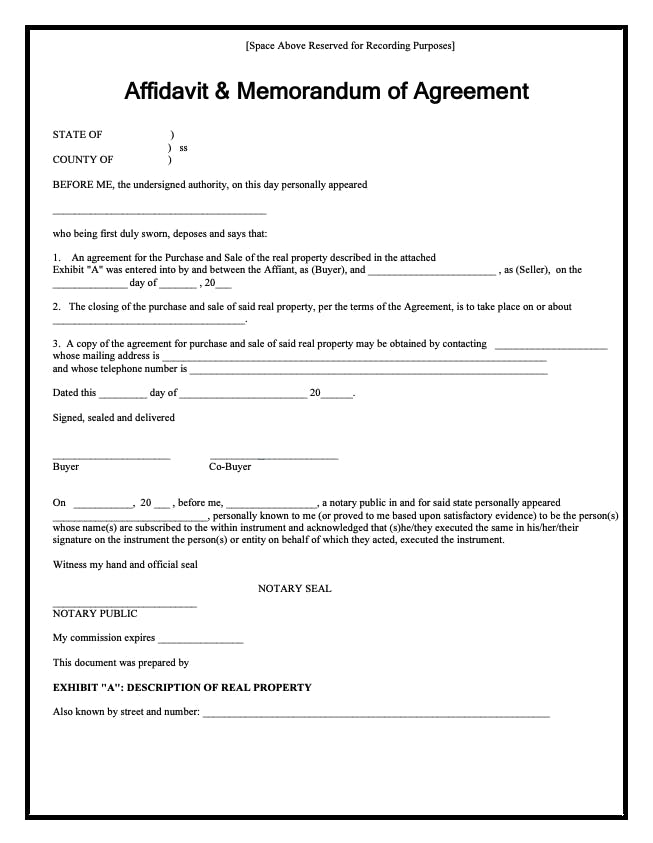
Note: Any sample contracts contained in this guide are for example only. They should not merely be duplicated without considering specifics and details of your particular situation. They are not intended to cover each and every real estate transaction or situation.
Next, we'll take a look at some of the most commonly asked questions associated with an Affidavit of Memorandum.
A: No, an Affidavit of Memorandum is not the same as a lien. While both documents establish a financial interest or claim on a property, a lien is actually a legal claim that provides the claimant with the right to foreclose on the property to satisfy the debt.
An Affidavit of Memorandum acts as notice of the claim or interest but does not grant the claimant the right to foreclose.
Yes, an Affidavit of Memorandum can be removed in certain circumstances.
For example, if the claim or interest being asserted has been satisfied or resolved, the involved parties can file a release or satisfaction document with the county clerk's office to remove the affidavit from the property records.
There you have it: an Affidavit of Memorandum.
It acts as another layer of protection during the real estate transaction process.
So, do you need one for your next real estate deal?
Use this guide to help you make the most informed decision for your next real estate deal.
Free Property Search
Find Your Next Wholesale Deal, House Flip, or Rental Property Investment.
Search Now